The Franktown Interview
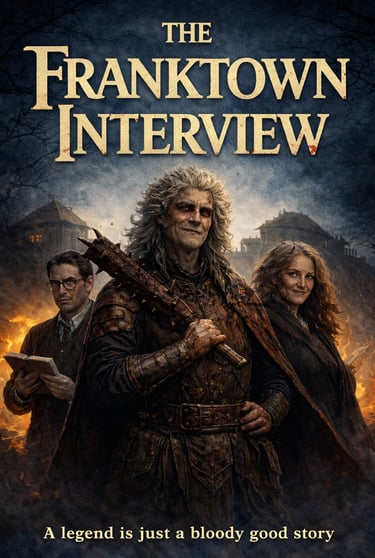
Three hundred died before dawn. Only one name survived it. On All Hallows’ Eve, 1807, a glowing spectre delivered a quest to the people of Frank Fort: survive until sunrise. What followed was chaos, fire, and beasts torn from nightmare. When the blood dried and the monsters dissolved into smoke, one figure stood ready to claim the legend. Archibald the Magnificent, self-proclaimed vampire, warlord, and hero of the night, insists he alone defended the fort from an apocalyptic horror. His familiar nods. His wife laughs. The truth lies somewhere between polished armour, river mud, and a conveniently timed final blow. Told through a sharply witty interview that spirals from grandiose boasting to cutting confession, The Franktown Interview peels back the fragile machinery of myth-making. It is a tale of monsters, ego, reluctant heroism, and the quiet man who did the real killing while history looked the other way. After all, legends are rarely written by the brave. They are written by the loudest.
SHORT STORIES
2/10/202611 min read
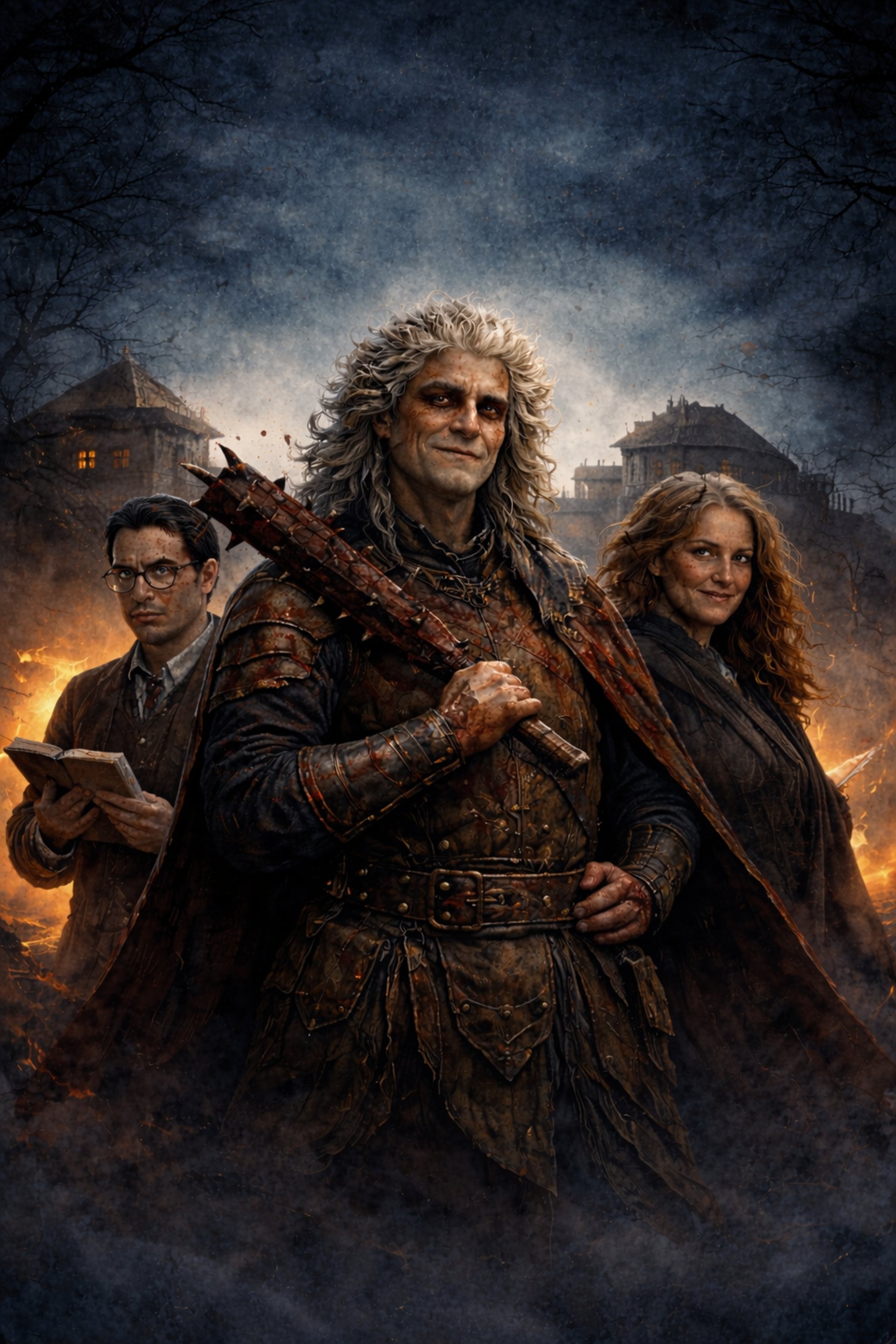
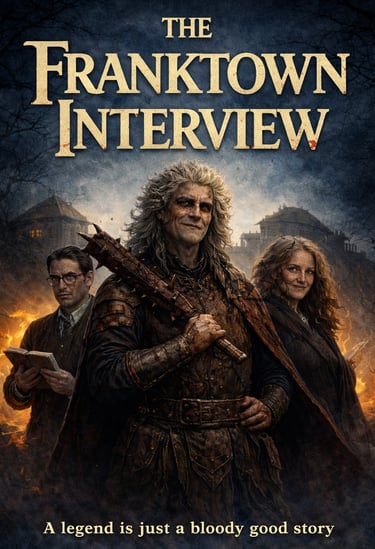
“Interview commencing at the eighth hour of the evening. For the record,” I began, “this is an interview with the self-proclaimed vampire, Archibald the Magnificent, who has instructed, or I guess it is more correct to say decreed that the word Magnificent in his name be written in a larger and more decorative hand than the rest. He has also insisted I provide an exact description of his attire.”
I inhaled, bracing myself for the catalogue. “He wears deerskin leggings bound with dyed cord, a mantle of reed and hide still glistening from the rain, and across his leather chest piece, clay-red spirals, once exact, now blurred with sweat and, let us say, a streak of blood. At his throat, a collar of shell and copper, the sort of adornment one might expect of a warlord of note. At his hip rests a polished war club, carried with all the gravity of a sceptre, and beside it a European blade in a deer-hide sheath, its hilt wrapped in bright cloth that has, by all appearances, crossed an ocean to reach him. His wrist shimmers with brass bangles that chime with every gesture. And crowning it all, a powdered wig of such height and curl that one might almost believe Versailles had misplaced a courtier to these shores.” I lowered my quill. “Will that suffice?”
Archibald straightened, shoulders broadening as if a portrait painter had just entered the room. “It will suffice. Although—” he wagged a finger, “I would have used the term splattered with blood, not streaked. Much more heroic. And these are not shells, they are bones. Bones of mighty beasts I personally slew. A crucial distinction. Also, I did not ask for the title "The Magnificent" to be larger. I proclaimed it, with all the authority befitting my station. History must, after all, be etched not only in truth, but in a splendour most fitting for my eternal legacy.”
“And, so it shall,” I muttered, turning to a fresh page. “Now, if you please: in your own words, recount the event of the night in question. One thirty-first of October 1807, All Hallows’ Eve. Location, Franktown.”
“Frank Fort,” Archibald corrected, stabbing the air with a finger. “Only lazy scribes and looser tongues call it Franktown, or worse, Frank Towne. You must record it properly, or the truth will rot before it is even told.”
“Frank Fort, then. Thank you for the clarification.”
Archibald inclined his head as though he had just salvaged the reputation of a kingdom. “Yes. History will thank me. Now, as to what happened that night. It is, as you can plainly see from my bloodied state and somewhat dishevelled appearance, quite the harrowing tale.”
“Dishevelled appearance,” I echoed, jotting it down.
Archibald leaned forward, lowering his voice as if he were about to unsheathe a holy secret. “I do not know if you give credence to such things as ghosts. But it began when a spectre appeared before me: a dreadful, floating rectangle, glowing like some unholy window into the beyond. It declared that I, and I alone, had been chosen not only to defend the fort against an unholy beast of the apocalypse, but also to survive until dawn. A quest I accepted with unmatched valour, for no one else in Frank Fort possesses the courage or the strength to shoulder such a deed.” He thumped his chest as if for emphasis, smearing fresh streaks of mud and blood across the spirals. “After all, I have outlived thousands of dawns. A single apocalyptic beast was hardly a cause for concern, at least where courage is concerned. Herbert will vouch for that.”
“For the record,” I inclined my head, “Herbert Picklehatch, Archibald's Familiar, is present. Mr Picklehatch, do you have anything you’d like to add to your master's statement?”
Herbert shifted in his chair. “Uhm… no, not really. Only to say that my master is, of course, most valiant. And… most brave.”
Archibald nodded gravely, as though the words had been chiselled into stone. “Yes. Precisely so. Most valiant. Most brave. Write that down twice.”
I dutifully made a note, though only once.
“So, after the spectre appeared and you accepted your quest,” I prompted, “what happened next? Can you describe the events that led to your inevitable victory over darkness?”
“Now, I would not say I defeated darkness,” Archibald said, his wig slipping to the side slightly as he shook his head. “After all, as a vampire, I am a creature of darkness. To destroy darkness would be to destroy myself. No, no. It is far wiser to say that I harnessed my own inner darkness to overcome that of the beasts.”
“I see,” I murmured flatly, quill scratching.
“But to return to the matter at hand,” Archibald continued, “once the spectre vanished, the earth began to tremble, and the air filled with screams. So many screams. And so, of course, the very first thing I did was retrieve my armour from storage. Sadly, it was very dusty… and one can’t possibly slay a beast of the apocalypse in dusty armour; it projects entirely the wrong image. So, I ordered Herbert to give it a good polish.”
From the corner, Herbert coughed discreetly into his sleeve.
“Then,” Archibald went on, “I fetched my club. It is an ancient tradition for me to carry my club into battle. Sadly, that too was dusty, so I had Herbert polish that as well, after which I did my stretches.”
“Stretches?”
“Yes. Stretches. Very important. No one wishes to suffer cramp in the middle of battle.” Archibald narrowed his eyes as if viewing a past memory. “The last time I neglected to stretch, my old familiar, Vagner, lost his head.”
“Cramp made it so you were unable to defend him?” I asked carefully.
“No, no,” Archibald said with a dismissive wave. “I suffered a dreadful cramp in my left thigh. The pain was such that I clutched it in reflex, and in the process, accidentally cut off Vagner’s head. He was standing far too close. Entirely his own fault, really.”
“Okay… back on topic,” I said, forcing a smile. “How long would you say it took you to get ready for battle?”
“Oh, no longer than a couple of hours. Three at most. After donning my armour, fetching my club, and performing my stretches, I was essentially prepared. Of course, by then it was the tenth hour of the evening, so I naturally needed a quick dinner to keep my energy up. That only took Herbert another hour to fetch, and then I was fully ready.”
I let my quill hang in silence. “So… several hours had passed after the apocalypse began, before you made your entrance?”
“Naturally,” Archibald said, leaning back with smug satisfaction. “It is never wise to arrive at the very start of a battle. Most of the time, you end up standing about, waiting, while others shuffle into place. Very dull. Additionally, in my experience, humans tend to appreciate feeling included. If you deny them, they whine and complain— ‘oh, we never get to share in the glory.’ It is better to let them have their moment before one such as I steps forward.”
I frowned. “You are aware that several hundred people died in those first few hours?”
Archibald nodded gravely. “Well, yes. Of course. Death is unavoidable in battle. There is always collateral damage. The important thing is that, when it truly mattered, I was there.”
I scribbled down a note I doubted history would ever bother to read: Collateral damage = several hundred dead.
“So, when you arrived, what did you find?”
“Well,” Archibald said, as if sifting through an album of his own glories, “that depends on how one defines ‘arrived.’ By the time I stepped from my door, the battle had already come to me in the shape of a most hideous beast. Ten to twenty feet tall, eyes like molten steel, claws and fangs that gleamed like polished blades. You know, your typical apocalyptic monstrosity. Well, anyhow, it towered over several dozen of my personal peasants, or “feeding stock”, as I prefer to call them, and, not wishing to see my blood supply mangled, I did what any brave lord would do: I crept up behind it, gave it a good wallop with my club to attract its attention, and then drew it away.”
“You drew it away from the people? You didn’t simply slay it?”
“Just so,” Archibald said, with all the solemnity of a man laying down royal law. “A distraction, executed with finesse. One does not merely swing; one composes. It’s an art form. Besides…” He lifted a finger. “To strike it down on the spot would have been most unwise. A creature of that magnitude, thrashing in its death throes, might have crushed a dozen peasants. No, no, better to lead it elsewhere, to a stage worthy of my triumph.”
“Ah, I understand,” I said, quill scratching to keep up. “So, you drew it away not only to save the folk under your care, but also to give yourself room to manoeuvre, thus ensuring you space to make a true spectacle of the killing?”
“Precisely.”
“And how far would you say you lead it?”
“Well, my first thought was to lure it only a short way from the manor. But after careful reflection, I decided it would be wiser to draw it down toward the river. A tactical decision. One, I believe, that paid off handsomely in the long run.”
“Ha!” A sharp voice cut through, dripping with scorn. “Tactical, he says. Tactical, my arse.”
I looked up to see a haggard-looking woman sweep into the room, skirts trailing, eyes flashing with delight at the chance to wound.
“He hit it with a stick,” she exclaimed, jabbing a finger at Archibald. “A stick! Then he screamed like a tavern wench getting buggered and legged it like some newly endarkened fledgling sprinting from the sunrise. He then reached the river, tripped over his own feet, and went arse-over-tit straight in. That’s not rainwater dripping from his armour, dear interviewer, that’s river muck, shame, and the lingering scent of his own bloody cowardice.”
Archibald’s jaw worked soundlessly for a moment before he found his words. “Wench! I thought I nailed you in your coffin. How did you get out?”
“For the record,” I said, dipping my quill in fresh ink, “Archibald’s wife, Lady Nadja, has now joined the interview.”
Nadja folded her arms, lips curling into a cruel little smile. “By opening it, obviously. I am a vampire, Archie, not some fragile human child. Perhaps you’d lack the strength to lift a few pins…”
Archibald sputtered, face blotching with outrage. “This is my retelling of events! History demands dignity and a noble voice, not the incessant cackling of a woman who mistakes mockery for contribution!”
Nadja’s laughter rang out, sharp as shattered glass. “Ha! Dignity? You call shrieking and bellyflopping into a river dignity? Write this down, Mr Interviewer, and make it clear: Archibald The Magnificent, greatest warrior of his time, nearly drowned in one puddle with a current.”
I coughed delicately. “Puddle with a current. Noted.”
“Silence, woman!” Archibald snapped, striking the arm of his chair with a crack. “You seek only to undermine me with petty jealousies.”
“Jealous? Of what? Your ridiculous wig? Your mildew-scented mantle? The only thing I envy is Herbert’s patience, forced to endure your endless blathering night after night. If you want a true accounting of events, it is I you should be speaking to, not this pompous, soggy corpse.”
Archibald bared his fangs in outrage as I pinched the bridge of my nose. “Perhaps now is a good time to pause? Collect our thoughts, maybe? And perhaps have a drink.” I cleared my throat, trying for professionalism. “Your familiar mentioned refreshments when I arrived. I might take him up on that offer and leave you two to, ah, straighten out whose version of events is correct. We can resume in fifteen.”
I gathered my quill and parchment and rose with what dignity I could summon. Herbert gave me a look of quiet gratitude and nodded once.
“Wine,” he whispered, sounding tired. “Yes. Wine will help.”
Behind us, Archibald and Nadja were already at one another again, voices rising in overlapping recriminations.
“So, what really did happen?” I asked, following Herbert down a narrow passage into a side room that contained nothing but two chairs, a table and a cabinet sagging with bottles. “As his familiar, I assume you were witness to everything?”
Herbert sighed in a way that suggested this story had been told many times before. He opened the cabinet and poured generously into two cups without asking my preference, then slid one across the table.
“By your master’s account,” I said, settling into a chair, “he slew a single beast? From what I’ve heard from the townsfolk, however, there were several dozen?”
Herbert rubbed at his temples and let out a tired laugh. “Dozens, yes. At least. They came from the treeline like shadows given teeth. The screams, well, you can only imagine.” He glanced toward the door where the muffled argument still bled through. “As for the master, no. He did not truly slay a beast. He swung at one, ran for his life, tripped on his cape and fell into the river. The rest was left to… others.”
“Others? Meaning you?”
Herbert stared into his glass for a long moment before he spoke. “You must understand, my master loves a story. He also requires being at the centre. It keeps him bright. It is easier, perhaps kinder, to let him have it. People prefer a single name to remember anyway.” He set the glass down with deliberate calm. “In truth, while he fussed with armour and demanded polishing, I slipped out the back. The beasts were already among the houses. I moved through the alleys, through smoke and fallen lanterns, and I killed them.”
“Killed them? You?”
Herbert smiled, not proudly but like a man stating a fact.
“Yes,” he said simply. “I know I don’t much look the part, but I do, in fact, come from a long line of monster hunters. My family in the old country made its name tracking and killing creatures of the night. Vampires included.” His mouth twitched into the faintest smile. “So yes, killing them came naturally. It’s in my blood.”
He gestured toward the door, where Archibald and Nadja’s voices still tangled together in furious counterpoint. “The irony, of course, is that I was originally sent here to kill him. Archibald the Magnificent.” He let the name hang with faint amusement. “But when I found him, all bluster and wigs, strutting about like a stage actor waiting for applause… well, it would have been like slaying a child. A boisterous child, admittedly, but harmless all the same. My family hunted terrors that could level villages. He could barely keep a fire lit without setting his own cape alight. So, I let him be.”
I raised my quill. “Apologies, I find myself a little confused. If you were unwilling to kill him, why did you stay?”
Herbert poured the last of the bottle into his glass. “Because opportunity rarely knocks twice,” he swept a hand at the room. “Look at it — the chandeliers, the tapestries, a bloody ballroom with no one left to dance in it. How often does a monster hunter stumble across a manor like this and live long enough to enjoy it? I’d have been a fool to leave.” He took a slow sip and let a sly smile appear. “I still plan to kill him, of course. That part hasn’t actually changed. I just need to find where the old bastard’s hidden the deeds first. Would be a terrible waste to put a stake through his heart only to discover I’d done myself out of the property.”
Herbert leaned back, shoulders sinking. “The funny thing is, if dear old Archi had paid attention to the quest message, which, for the record, was given to everyone in town, not just him, he’d have seen the other notices. The system bestowed new powers on all who received the quest to fight the apocalypses. He missed all of it in his panic.”
I frowned. “So, you’re saying that everyone in Frank Fort received new powers?”
Herbert nodded, then held out his hand. A flicker of pale light gathered in his palm and shaped itself into a dagger of condensed shadow. “Mine manifests as any weapon I can imagine. Others gained fire, healing, speed. Together, we drove the beasts back.”
The dagger dissolved into smoke, leaving only the faint smell of scorched air.
“So,” I said delicately, “if the townsfolk and you were responsible for the slaughter, where does your master’s version fit in?”
Herbert shrugged, the movement weary but without bitterness. “When I dragged him out of the river, spluttering and stinking of reeds, the fight was nearly over. Only one beast remained, staggering and half-dead from our blades and fire. My master, drenched, armour dented, wig half-off, strode forward with all the pomp he could muster and stuck it through. It fell and dissolved into smoke, just like the rest.”
“And because they all vanished the same way…”
Herbert nodded. “He believed it was the only one. The great foe, his alone to slay. And no one cared to correct him.”
I set my quill down. “So… Archibald the Magnificent did, in fact, kill a beast?”
Herbert sighed. “If we’re being technical, yes. One that was already dying. But for him, that was enough to remain a legend.”
From the other room came Archibald’s voice, loud as a trumpet and twice as self-satisfied. “Write this down, history! I saved Frank Fort with my own hand!”
Herbert tipped the bottle, found it empty, and gave a tired smile. “History is, after all, what we choose to write of it.”
The Franktown Interview: Halloween, 1807