Forge & Folly
Wendell never asked to be his father’s apprentice, but in Taldar’s forge, saying no isn’t an option. Every day is sparks, smoke, and the constant threat of being blown through a wall. Taldar calls it brilliance; Wendell calls it madness. Between runaway runes, singing buckets, and swords that would rather kill their wielder than serve them, the two must find a way to turn disaster into craft. Or at least survive long enough to try again tomorrow.
SHORT STORIES
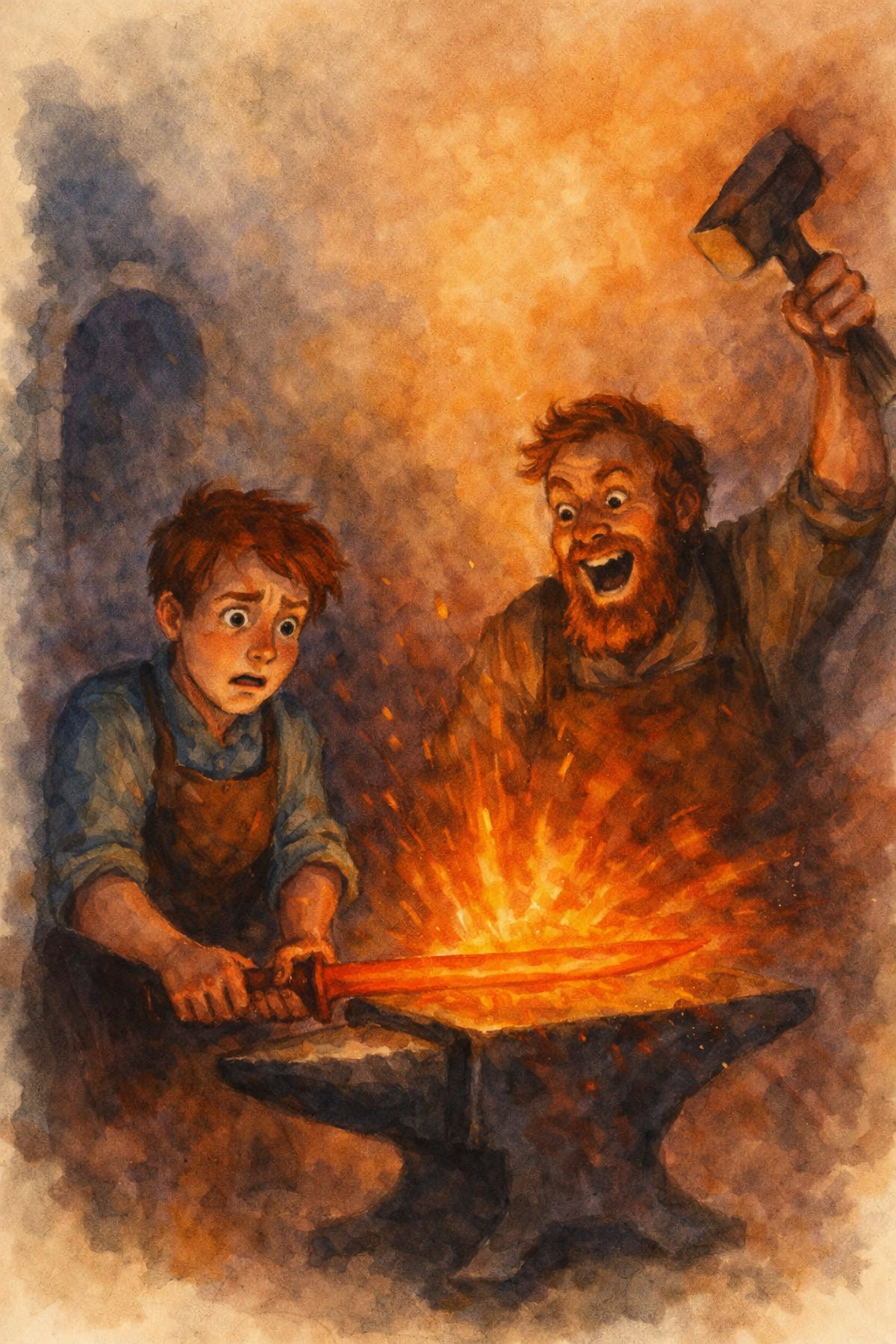
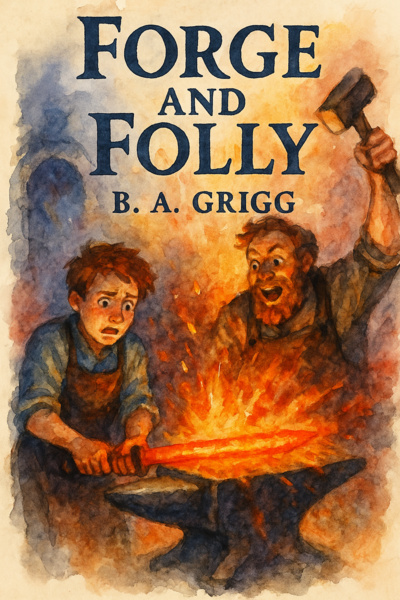
“Hold it steady, theres a good lad.”
Taldar’s voice rasped through the thick forge air, dry and final — the sound of a man who knew things didn’t always survive being named. He hunched over the anvil, eyes locked on the glowing blade. His posture suggested reverence. His hands did not. They hovered rough and scarred above the steel, twitching with impatience. A priest’s poise, perhaps, but a butcher’s touch.
Old burns marked his knuckles. New ones, still pink, mapped out recent regrets. He traced the blade’s edge, coaxing the runes awake with fingers better suited to breaking bones than crafting magic. Each movement was a risk. Each breath had weight. The syllables he muttered were not speech, but invocation, sharp, curling words that clung to the air like smoke off quenched iron.
The forge hissed in the corner, its coals clinging to heat with the defiance of an old man denied his routines. The air smelled of copper, burnt cloth, and something disturbingly organic that Wendell hoped wasn’t his own eyebrows. Grime ruled the walls. The ceiling bore blackened streaks—failed castings, backfired sigils, and one incident no one spoke of anymore.
On the anvil, the blade shifted. Not shimmered, but seethed. Azure light pulsed beneath its etched surface, the runes flickering with reluctant life. They didn’t glow so much as twitch like a wounded thing, angry to be disturbed. A low hum bled out from the steel, dull and steady, the kind of sound Wendell now associated with either enlightenment or a minor explosion. In his experience, it was usually the latter.
He stood across from his father, arms locked, hands gripping the hilt until the skin around his knuckles went pale. His shoulders trembled under the strain. Sweat stung his eyes, but he didn’t blink. The last time he’d blinked, the workshop had grown legs and tried to walk into the river.
“Are you sure this is right, Father?” he asked, his voice tight. “I swear the binding rune’s meant to follow the spine, not… whatever that is.”
He gestured faintly with his chin toward the glowing etchings, which curved along the blade’s underside like drunken centipedes.
Taldar didn’t answer at once. His focus was absolute, his gaze narrowed behind soot-smeared spectacles that looked more welded on than worn. Only after whispering another incantation—something thick and wet in a dead tongue that made the rafters creak in quiet protest—did he glance up.
“You really want to lecture me on rune alignment, boy?” The words came easily, almost conversational, but the edge beneath them was all iron and fire. “Or would you rather we make something that actually matters—something that might, gods forbid, work for once? Now hold still. Unless, of course, you’d prefer this to go the way of Granpoppy’s old hammer. You do remember the hammer, don’t you? The one I accidentally enchanted with a guilt complex?”
Wendell shivered. “How can I forget. It kept apologising every time it hit something.”
“And sobbed itself to sleep in the corner every night.” Taldar gave a wistful sigh, as if mourning a particularly tragic pet. “Damn shame, really. Had the best balance I’ve ever seen.”
He shifted his stance, thumb sweeping another sigil into the charged air. The rune flared, glowed, and fizzled out with a sullen pop. Taldar muttered something under his breath, a tangle of profanity that spanned three dialects.
Wendell didn’t so much as blink.
This was the critical point—the moment when things traditionally veered from merely unwise to someone-fetch-the-priest. Wendell had been here before. Far too many times. Every time his father launched one of his so-called “DIY Projects,” something got lost. Two eyebrows to combustion last spring, one boot incinerated the time before that, and a week spent speaking entirely backwards after a botched translation rune had taught him—loudly and repeatedly—the value of silence.
He’d learned the signs: the twitch in Taldar’s left eye, the way the forge's glow deepened like it was holding its breath, and most of all, the swearing. When his father started stitching curses together from three different tongues—one of them extinct—it meant reality wasn’t just bending anymore. It was starting to fray.
A spark snapped from the blade.
It zipped across the coal-stained floor, hissing like a kettle until it struck a bucket of discarded nails.
The bucket groaned. Then with a shudder, it levitated a full inch off the floor, rotated once as if getting its bearings, and began to hum… “The National Anthem of Thresh?”
Wendell closed his eyes.
There were some things a man simply learned to ignore for the sake of his sanity—possessed cutlery, sentient soup, haunted laundry. This was one of those moments. The nails inside the bucket began to tremble, then rattle in rhythm with the tune, like tiny metallic dancers compelled by some terrible, patriotic curse to perform for their lives.
“Don’t lose focus,” Taldar snapped. “We’re nearly through the second phase.”
“The second phase?” Wendell hissed. “The first phase nearly turned my spleen inside-out!”
“Oh, come now, that was barely a ripple. You’ve got no sense of adventure.”
“I’d prefer a sense of safety, if it’s all the same to you.”
“Safety,” Taldar muttered, his tone derisive, as if Wendell had just proposed replacing the forge with a pastry oven. “Boy, if we sought safety, we’d be baking bread, not bargaining with reality.”
“Bread doesn’t explode when it’s mildly offended!”
“Obviously, you’ve never met dwarven yeast. Now, a little bit to the left,” Taldar barked. “No—your other left, boy! Gods preserve me from the youth.”
“You’re the one who insisted I help,” Wendell hissed through clenched teeth. The blade trembled as the runes flared brighter, casting spectral shadows across the walls.
“Of course I did,” Taldar said, stepping back and rubbing a soot-stained hand across his brow. “Every master needs an assistant. It’s tradition. And sometimes the extra hands are useful for catching things that want to escape.”
The blade pulsed. Not gently, not like it approved. No—this was the kind of pulse one got from something alive and thoroughly irritated. Wendell could’ve sworn he heard it whisper. Maybe. It was hard to tell beneath the rising thrum that made his teeth ache.
Taldar turned and reached for a jagged grey crystal. It glowed at his touch and shivered slightly, as though unsure whether to trust him or scream.
“I’m going to feed it a little surge from the core,” he said conversationally. “Just enough to nudge it into coherence.”
“I’m fairly certain that’s what you said before the garden caught fire.”
“That was an entirely different situation,” Taldar replied, setting the crystal on the anvil. “That axe was haunted to begin with.”
“You summoned the spirit into it!”
“And it was already angry! Not my fault.” He leaned down and whispered to the crystal—soft, coaxing syllables that made the lights flicker. The magic took.
The runes flared a brilliant, blinding blue. The hum deepened to a growl. Something scurried in the rafters, then stopped and dropped.
Wendell flinched as a rat carcass thudded to the floor beside him, still twitching, faintly smoking. The sword vibrated, jerking like it was preparing to launch. He tightened his grip.
“This isn’t holding,” he warned. “The binding's unstable, the resonance is off, and I think it just snarled at me.”
Taldar didn’t look worried. He looked exhilarated. “Of course it’s snarling. That’s how you know it’s working. Means the runes are arguing with the enchantment. That’s where real power’s born—in tension!”
Wendell opened his mouth to argue—but the crystal chose that precise moment to explode.
It shattered with a sound like lightning being throttled, sharp and furious. A surge of blue fire shot up the blade and lashed outward in a jagged arc, catching Wendell square in the chest and flinging him across the workshop like a forgotten rag doll hurled by a petulant god. He hit the far wall with a solid thud, bounced off a stack of scorched books—several of which voiced their indignation—and collapsed in a groaning heap amid ash, splinters, and a mostly-dead rat that looked every bit as startled as he was.
The sword shrieked.
Not metaphorically. It let out a piercing, metallic wail like steel remembering trauma.
Then it launched itself from the anvil.
It spun mid-air in a blur of motion, carving luminous runes into the stone walls with every pass. Sparks spat from its edge as it ricocheted off a pillar, whirled past Taldar’s head close enough to trim a few precious beard hairs, and finally embedded itself halfway through a thick wooden beam with a solid, vibrating thunk.
The glow was no longer the calm blue of control but a violent, twitching crimson, pulsing in erratic rhythms like a heart on the verge of going into cardiac arrest.
“Well,” Taldar said, brushing off embers from his sleeve, “that’s new.”
Wendell groaned, rolled over, and coughed. Smoke curled from his tunic. “You think?”
Taldar stepped forward and pried the trembling blade from the beam. It shuddered in his hands. Sparks flickered along its edge. The runes spasmed, half-formed and twitching.
Wendell sat up slowly, wincing through the ache in his ribs. “It’s trying to kill us.”
“It’s trying to express itself,” Taldar corrected, running a hand almost tenderly along the fuller, as if soothing a temperamental cat. “This is raw power, lad. Untamed, yes—but that’s how it begins. It’ll settle.”
The blade howled.
A ripple of red energy surged along its length, convulsed, and detonated.
The explosion wasn’t fire. It was noise. A thunderclap of arcane backlash that shattered the silence, cracked the stone, and ruptured the blade into blinding, radiant shards. In an instant, the workshop became a war zone.
Fragments of glowing steel embedded themselves in every available surface. One punched through a stack of ledgers and set them smouldering. Another speared the toe of Taldar’s boot, pinning him in place like a museum exhibit. And a third zipped past Wendell’s cheek, nicked his ear, and buried itself in the support beam with a hiss.
Wendell blinked. “Father,” he said, voice hollow, “you’ve invented a suicide blade.”
Taldar examined the hilt, now empty, and sighed. “It wasn’t supposed to explode. It was meant to… evolve.”
“It evolved,” Wendell muttered. “Into shrapnel.”
Taldar tilted his head, eyeing the still-glowing fragments embedded in the rafters. His eyes then tracked to another fragment that floated, rotating lazily in the air and glowing a vivid orange. “You say that like it’s a bad thing.”
“It is!”
“But look how it pulses. That’s not death, that’s transformation.”
“That, is a flaming fragment of molten death.”
The air shimmered again as the fragments hissed, cracked, and lit up with a light so bright it was hard to look at. Then, with a soft pop, it shot across the room and set fire to an oil-soaked rag hanging from a peg on the wall.
Wendell crossed his arms. “You’re going to bring the whole place down.”
Taldar just chuckled. “Every revolution starts with a little destruction.”
“You’re not a revolutionist, Father,” Wendell snapped. “You’re a hazard with a beard.”
Taldar beamed. “And you’re my apprentice. That makes you complicit.”
“I’m not sure being an accessory to idiocy makes me complicit,” Wendell muttered.
Unfazed, Taldar wandered over to a coal-blackened wall panel, flipped it open, and tapped a glyph crusted with ash and neglect. A pale green shimmer rippled through the forge.
With a series of reluctant whoomphs, the fires died out.
“There,” Taldar said, brushing soot from his hands. “Crisis averted.”
“Don’t you mean crisis postponed?” Wendell countered, eyeing the fragments still embedded in beams, floorboards, and his father’s boot. “I already know you’re going to start the whole enchantment process from scratch. On a different sword.”
“Of course,” Taldar said brightly, plucking the glowing shard from his boot like a wayward pebble. “Only next time, we’ll get it right.”
Connect
Join my Discord if you’d like to dive deeper into my worlds, chat with other readers, share your fan art, or even give me a well-deserved roasting.
© 2025. All rights reserved.